Introduction
India celebrated Diwali, the grand festival of lights, with its characteristic splendour and spirit of togetherness. Across homes and streets, lamps illuminated the night, and hearts were filled with warmth and joy. In eastern India, the festivities also coincided with Kali Puja, adding to the cultural vibrancy of the season. Yet, as every light casts a shadow, the celebrations once again revealed an environmental reality often overlooked- air pollution immediately after Diwali.
Kolkata’s air quality deteriorated significantly in the pre-Diwali period. The city witnessed widespread and prolonged bursting of firecrackers, many of which violated prescribed time limits and green norms. By the next morning, a thick haze blanketed the city, leaving behind the burnt smell of gunpowder and visible discomfort among residents, especially children and the elderly.
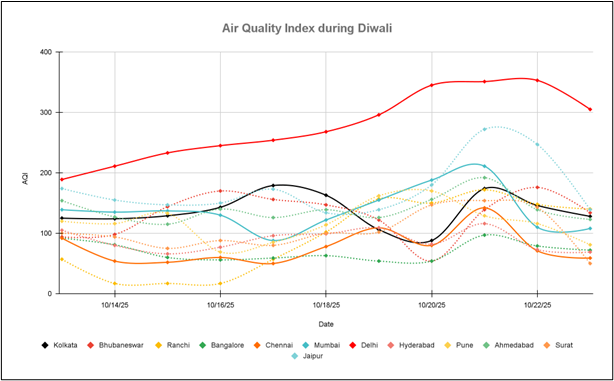
This blog analyses Kolkata’s Diwali air quality trends, compares them with other metropolitan cities, and outlines immediate and long-term actions for both citizens and authorities to mitigate the recurring pollution surge.
Amid this growing concern, SwitchON Foundation continues its efforts toward Clean Air and Sustainable Cities. Through evidence-based research, citizen engagement, and policy-oriented communication, the organisation works to drive behavioural change and support policymakers in shaping a cleaner, healthier future.
Kolkata’s air quality during Diwali
Kolkata’s air quality was very good in the initial days of October due to untimely rainfall caused as a result of the depressions at the Bay of Bengal. As the rains withdrew and the winter chill set in, pollution levels began to rise again. Kolkata is already challenged by high vehicular emissions, and air pollution remains a concern in the city, especially during the winter.
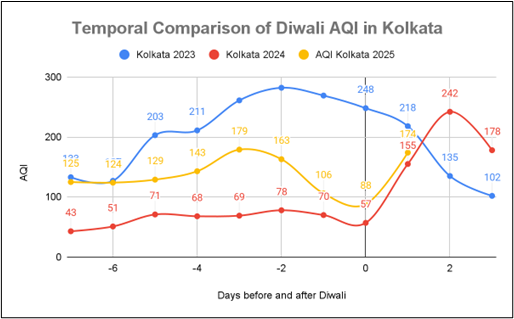
Data from the CPCB’s Sameer App revealed nitrogen dioxide (NO₂) as the dominant pre-Diwali pollutant. At this time, the city’s AQI remained within the ‘Moderate’ range (101–200) but showed a gradual upward trend. On Diwali day (20 October 2025), the AQI dropped to 88 — categorised as ‘Satisfactory’. However, on the very next day the AQI spiked to 174 (‘moderate’), with PM₁₀ emerging as the primary pollutant during Diwali. This sharp post-Diwali deterioration reflected the delayed impact of widespread firecracker emissions.
![Figure 1: Kolkata Air Quality Status in October Source: Sameer App by CPCB [* red dot denotes diwali day AQI]](https://www.switchon.org.in/wp-content/uploads/2025/10/Picture1-2.png)
Figure 1: Kolkata Air Quality Status in October Source: Sameer App by CPCB [* red dot denotes diwali day AQI]
Kolkata’s air quality displayed distinct pre- and post-Diwali patterns across its seven CPCB monitoring stations. In the pre-Diwali period (13–19 October), pollution steadily accumulated, with Rabindra Bharati University (RBU) recording the highest AQI, peaking at 281 on 17th October, followed by Jadavpur at 247, indicating levels capable of causing discomfort even among healthy individuals. Victoria Memorial and Ballygunge remained in the Moderate range, primarily due to PM₂.₅ and PM₁₀, while Fort William, Rabindra Sarobar, and Bidhannagar experienced relatively better air quality. Across stations, PM₂.₅ and PM₁₀ were dominant in Victoria, Jadavpur, and Ballygunge, whereas NO₂ was significant at Rabindra Sarobar, highlighting spatial variation in pollution sources.
On Diwali day (20 October), AQI temporarily decreased at all the locations, and all the locations recorded satisfactory air quality, with major polluted stations like Rabindra Bharati at 69 AQI and Jadavpur at 100 AQI. Despite this, PM₁₀ remained the key pollutant on the day, reflecting the initial impact of firecracker emissions.
The next day (21 October) saw a sharp AQI surge across all stations—Jadavpur at 204, Bidhannagar 189, Ballygunge 173, RBU 134—driven mainly by PM₂.₅ and PM₁₀, demonstrating the cumulative and delayed effect of festive activities. Overall, Jadavpur and RBU emerged as persistent hotspots, emphasizing the heightened post-festival health risks from particulate pollution. Jadavpur again reached the status of poor air quality.
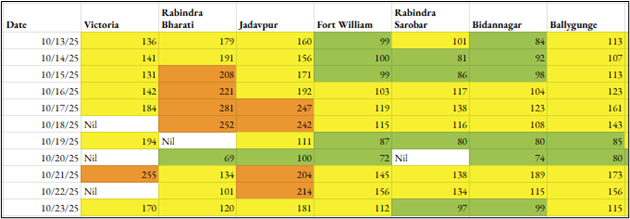
Table 1: Air Quality Calendar for the CPCB Stations at Kolkata Source: Sameer App by CPCB
 1
1  0
0